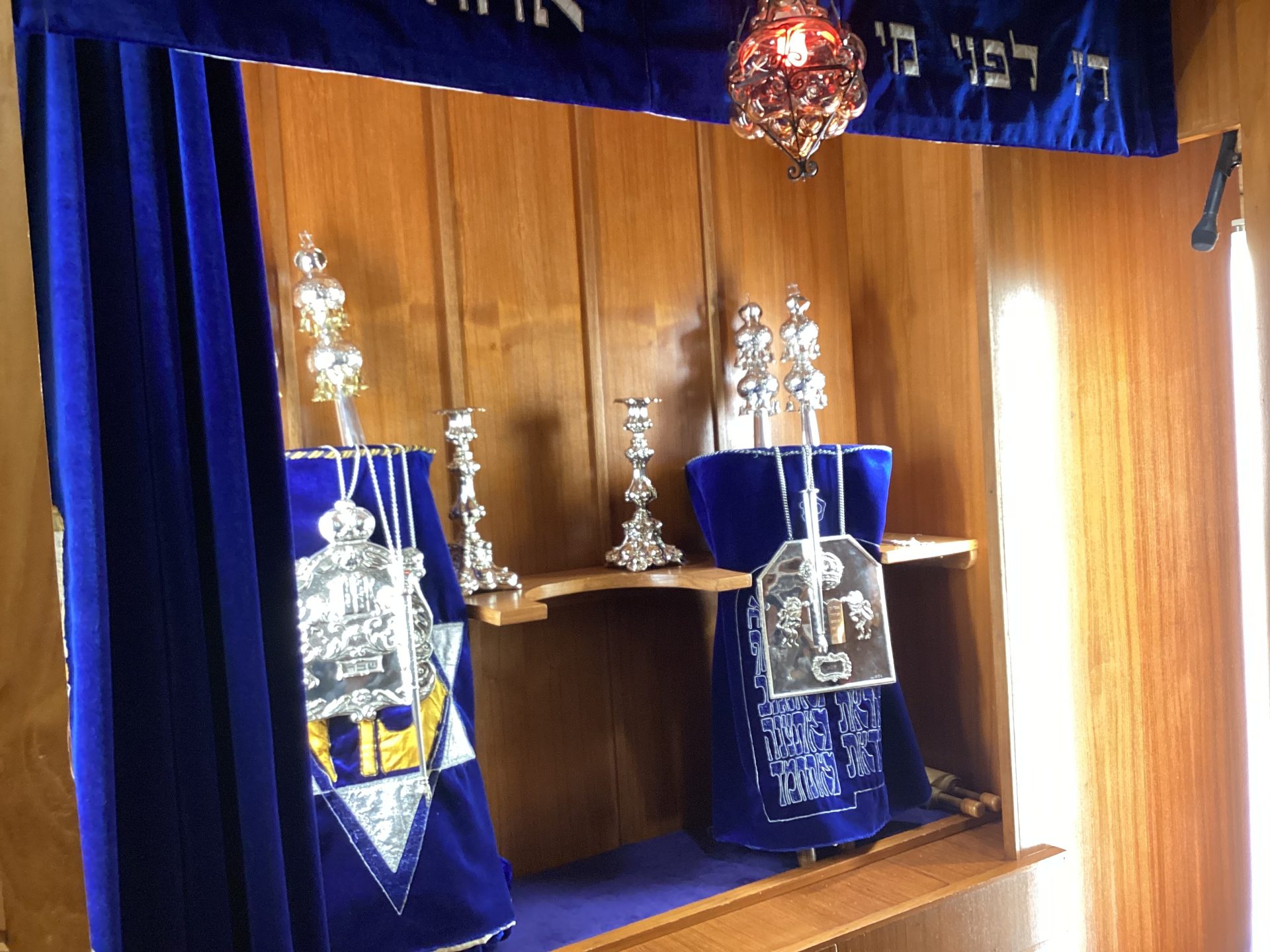
This morning, Year 5 visited a Jewish Synagogue in Newcastle as part of their learning of; Judaism in RE. We met Jonathan and Helen Brady who were our speakers for the day and who lead their progressive synagogue.
First, we learnt that the lectern that was in the hall turns out in the synagogue for when people are talking, however, in some other synagogues they are in the middle and are facing the other way. In a traditional synagogue, women and men sit separately, but in this synagogue they can sit together. We learnt that the role of a man is prayer and for women it is to say home and bring up the children. However, nowadays, women take a much bigger role in the progressive community, which includes prayers.
We then discussed about our collective worship in school, where the children explained what we do each day. We explained that our hall is a place of learning, pray and praise. We found out that the synagogue hall we visited was also similar to our hall at school. We did, however, find out that Jewish homes are more important than synagogues.
A child in class spoke about how today is ‘Holocaust Memorial Day’. Jonathan said that the holocaust is part of his lived experience because he has knew people who were hidden away in Amsterdam during WW2.
One question asked was; ‘How old is Judaism?’. Jonathan replied to the question telling the children that Judaism has been around for 3,500-4,000 years. Another question was; ‘Why do Jewish people kiss the mezuzah?’ Helen said that it is recognised as a rule which is what they respect. She added that she rules they live by are from the Torah, which tells them what they should do and live through.
A big topic of discussion was based around Shabbat. Shabbat starts on Friday night (when night falls and you can see 3 stars). It then ends on Saturday night. Jewish events start in the evening and finish in the evening. Before a the meal they light and bless the candles. Once they light the candles, no one is allowed to work (this includes turning lights on and off, shops being shut and no school). They drink grape juice or wine and say a blessing over it which means the ‘fruit of the vine’. They then wash their hands and say a blessing over 2 loaves of plaited bread. The 2 loaves represent ‘Manna from heaven’. They light the plaited candle at the end of Shabbat, which is a symbol to intertwine a good week beginning. The candle is then turned upside down and put into the grape juice to end Shabbat. A spice box is also sent around the room where they smell the cloves. Some of us said that the smell reminded them of cinnamon and Autumn.
Jonathan and Helen discussed Jewish celebrations with us, concentrating on bar mitzvah’s and bat mitzvah’s. Boys celebrate at age 13, whist girls celebrate aged 12.
At the end of the trip, the children learnt about Kosher food. We learnt that Jewish people do not eat animals such as pigs and rabbits. An animal, such as a chicken or duck, needs to be healthy before it is killed. The animal is killed in a particular way, which includes killing quickly. We found out they can eat fish such as; plaice, cod and haddock. But fish like prawns and lobster cannot be ate as they don’t have skin and scales. We learnt that food such as cheese and meat cannot be ate together and if they were to eat meat, a piece of fish can’t be ate until 3 hours pass.
Throughout the morning, we also looked at lots of different Jewish objects.